
Leonida Project GitHub: What Happened to the Repository
The Leonida GitHub repository went from 34,000 stars to a 404 in two days. Here is the verified history, how removals work and how to judge the forks.
The Leonida GitHub repository is the most visible artifact of the November 2026 GTA VI PC port rush. It went from a fresh announcement to more than 34,000 stars in about two days, then moved organizations and vanished. Visitors now get a 404. This page explains what GitHub actually recorded, what a 404 can and cannot tell you, and how to evaluate the forks that remain. The human side of the story is in Leonida project status→.
The original repository was transferred to a ProjectLeonida organization on November 23, 2026, and then became inaccessible. GitHub has not published a removal notice. A 404 is consistent with a takedown, a deletion, a rename or a switch to private, so the cause remains unconfirmed.
The repository's short life
Leonida was announced on X on November 21, 2026, with a link to a GitHub repository. The pitch was direct: a work-in-progress PC port of GTA VI, built by recompiling the leaked Xbox executable. The repository included code and documentation, but not game assets, keys or the executable itself.
Growth was explosive. Public trackers recorded more than 34,000 stars and thousands of forks within two days. Contributors opened pull requests, issues filled with requests and speculation, and the project's Discord became a gathering point for people who wanted a PC version.
On November 23, the repository was transferred from the creator's personal account to a new organization, ProjectLeonida. Transfers are normal in open source: they let a project share ownership and survive a single account's limits. In this case, the new location also disappeared shortly afterward.
What a 404 can mean
GitHub returns the same 404 for several different situations:
- The repository was deleted by its owner.
- The repository was made private.
- The repository was renamed and the old URL no longer redirects.
- The account or organization was removed.
- Access was restricted by GitHub after a complaint.
Only the last case involves the platform. The others are owner actions or ordinary repository management. Without a public notice, a court filing or a statement from the maintainer, an outside observer cannot distinguish them.
This is not a technicality. Coverage that says "GitHub removed Leonida" asserts a platform action that may not have happened. The accurate statement is that the repository became unavailable during a period of intense scrutiny, and that its creator said he quit.
How GitHub handles copyright complaints
GitHub publishes a DMCA takedown policy ↗ that describes the process: a rights holder submits a notice, GitHub reviews it, and the affected repository owner can respond. Removals are logged in a public transparency repository when they meet certain criteria.
A takedown of this kind would normally leave a trace. The absence of a public notice is weak evidence against a platform removal, but it is not conclusive: notices can be incomplete, and a repository can be removed for other policy reasons. The honest answer is that the public record does not establish the cause.
The forks and their claims
Forks appeared within hours. Some are exact copies preserved by users who expected the original to disappear. Others add a readme, a roadmap or a renamed build script. A few claim to have fixed the boot process.
The useful way to evaluate a fork is to ignore the description and look at the commits. A repository with a real effort has a history of small, technical changes: build fixes, platform stubs, shader tests, issue discussions. A repository with a renamed copy has one import commit and no subsequent work.
The GTA 6 PC port tracker→ applies the same standard to every project. Stars and announcements are not milestones. A commit history and reproducible output are.
Why the code was interesting
The technical premise was sound. Xbox Series X|S uses an x86-64 CPU, and its development environment is close enough to Windows that static recompilation is a plausible route. The same developer had applied the technique to Ocarina of Time, a much smaller game with a well-understood codebase.
The GTA VI problem is scale. A modern open-world game has a huge executable, a proprietary engine, a console-specific renderer and a content pipeline tied to signed packages. Recompiling the code is the first step; making the engine believe it is running on an Xbox is the rest of the job.
The repository's public claims reflected that early stage: executable validation, shader conversion, asset export and a boot path. None of them is a playable game, and none was independently verified before the code disappeared.

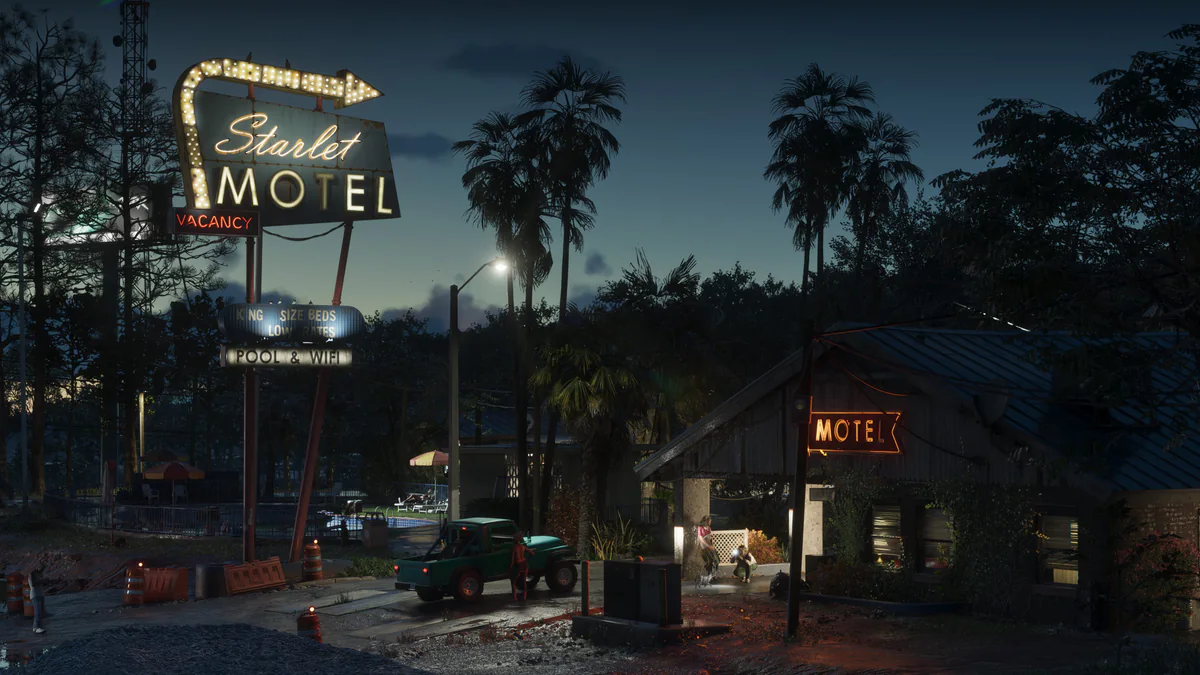
Image: Rockstar Games. Official GTA VI press screenshot.
Could the code come back?
Possibly. Forked copies exist, and the original author could publish again under a new name. A return would face the same constraints: platform work, asset validation, legal exposure and the attention economy that overwhelmed the first attempt.
A revived project would also need a governance structure. One teenager absorbing thousands of messages is not sustainable. A team with maintainers, a code of conduct and a clear scope has a better chance, though it still needs a working renderer.
What to do with a repository link
If you find a repository claiming to be Leonida or a successor, check four things before trusting it: the organization's history, the commit dates, the issue activity and whether the project publishes testable output. Do not run binaries from an unverified repository. Do not supply your game account credentials to a build script.
The legal risk is separate from the technical one. Distributing or using unauthorized copies of the game is copyright infringement in most jurisdictions, and the legal explainer→ covers the boundaries. A GitHub repository does not make the underlying files lawful.
FAQ
Why is the Leonida GitHub repository gone?
The cause is unconfirmed. The repository was transferred to a new organization and then became inaccessible. That pattern fits a voluntary deletion, a switch to private, a rename or a platform removal, and no public notice has established which one occurred.
Did GitHub delete Leonida?
There is no public GitHub notice confirming a removal. GitHub's DMCA process usually leaves a trace, but not every removal is published. Treat claims that GitHub deleted the repository as unverified.
Are the Leonida forks safe to use?
No fork has demonstrated a playable build, and running unknown binaries carries malware and account risk. Even a technically genuine fork would still require unauthorized game files to do anything useful.
How many stars did Leonida have?
Public trackers recorded more than 34,000 stars within about two days. Stars measure attention, not code quality or completeness.
Official source: GitHub: DMCA takedown policy ↗
Sources