
Leonida Project Explained: How the GTA 6 PC Port Was Built
Leonida was a static recompilation project that tried to turn the leaked Xbox GTA 6 build into a PC game. Here is how the approach works and where it stopped.
Leonida was an open-source project that attempted to run the leaked Xbox build of GTA VI on Windows through static recompilation. It appeared on November 21, 2026, two days after the console dump, and gathered tens of thousands of GitHub stars before disappearing on November 23. This page explains the idea, the pipeline and the technical limits. For the current state, see Leonida project status→.
Leonida was not an emulator and not a crack. It translated the console executable's machine code into C or C++, then tried to rebuild it against Windows-compatible components. It reached a boot window. It never demonstrated a menu, gameplay or a public build.
The idea in one paragraph
A console executable is a sequence of machine instructions written for a particular processor and operating environment. If the processor is the same family as a PC's, the instructions themselves are not exotic. What differs is the world around them: system calls, memory layout, graphics APIs, input, file access and licensing.
Static recompilation reads the executable ahead of time and produces equivalent source code. Developers then replace console-specific calls with their own implementations, compile the result for Windows, and fix whatever breaks. The appeal is speed: a translated game can run natively, without interpreting every instruction at runtime the way an emulator does.
The catch is that "equivalent source code" is not the same as "working game." Recompiled code still expects the original engine's assumptions, and every replaced call is a chance for subtle behaviour to diverge.
Where the name comes from
Leonida is the fictional state in which GTA VI takes place. The project used the name as a label, not as an official title. Its creator, a developer known as ItsNotRexed, announced it on November 21 with a short post describing it as a work-in-progress PC port. The announcement and early coverage are summarized by allthings.how ↗.
The same developer had worked on Hookshot, a static recompilation of The Legend of Zelda: Ocarina of Time for Switch 2. That background matters: the approach was not improvised for GTA VI. It was a technique the author had already applied to a Nintendo 64 game, where the codebase is small, well documented and widely reverse-engineered.
GTA VI is a different scale. Its executable is larger, its engine is proprietary and its graphics pipeline is modern. The techniques transfer; the effort does not.
The pipeline Leonida described
The project's public claims followed a recognizable sequence.
First, validate the executable. The team said it had checked the Xbox 1.0.2.1 binary and begun mapping its functions. Validation is the least glamorous stage and the most important: if the binary is incomplete or modified, everything downstream inherits the problem.
Second, translate the code. Static recompilation tools convert machine code into C or C++. The output is not clean, idiomatic source; it is a mass of generated functions that reproduce the original instructions. Developers then annotate, rename and replace the parts that touch the platform.
Third, replace the platform layer. Console services for memory, threads, files, input and networking must be reimplemented against Windows equivalents. This is where most projects spend most of their time.
Fourth, translate shaders. The game's GPU programs are written for the console's graphics pipeline. They must be converted to SPIR-V or another PC-compatible format and then tested. Leonida claimed 26,503 shader conversions, a figure reported by GameGPU ↗.
Fifth, handle assets. The project said it could export models, textures and audio, but it explicitly did not distribute game assets. Users would need their own copy of the game. That position is legally understandable and practically useless for anyone without the leaked build.
What "it boots" actually means
A boot window means the process started, loaded some libraries and reached an initialization path. It does not mean the engine initialized correctly. It does not mean a menu appeared. It does not mean a frame was rendered with game content.
In a recompilation project, boot is the first visible milestone because it proves the binary can execute at all. The next milestones are harder: a working renderer, asset streaming, input, audio, and a game loop that does not deadlock. Each one can take weeks or months, and each one can reveal that an earlier assumption was wrong.
The footage that circulated on November 23 showed a window and scrolling initialization text. That is consistent with a project at the very beginning of the long middle, not at the end.
Why assets were excluded
The repository reportedly contained no game files, no keys and no executable. Contributors were expected to supply their own copy. This is a common pattern in recompilation projects: the code is published, the copyrighted content is not.
It also creates a legal distinction that is often lost in coverage. Reverse-engineering code for interoperability has a body of precedent. Distributing the game's assets does not. A project that stays on the code side has a stronger argument than one that ships a complete playable package.
That distinction did not protect the project from attention, and it does not answer every legal question. It does explain why the repository could exist publicly at all.
The contributions and the claims
Leonida attracted around 75 contributors and more than 34,000 stars in two days. Some of the pull requests were reportedly written with AI assistance, which is plausible for generated code and not inherently disqualifying. The useful question is not who typed the code but whether the result runs.
The project's claims were ambitious: shader conversion, asset export, executable validation and a boot path. Each claim is testable in principle. None was independently verified before the repository disappeared, and the disappearance removed the easiest way to check.

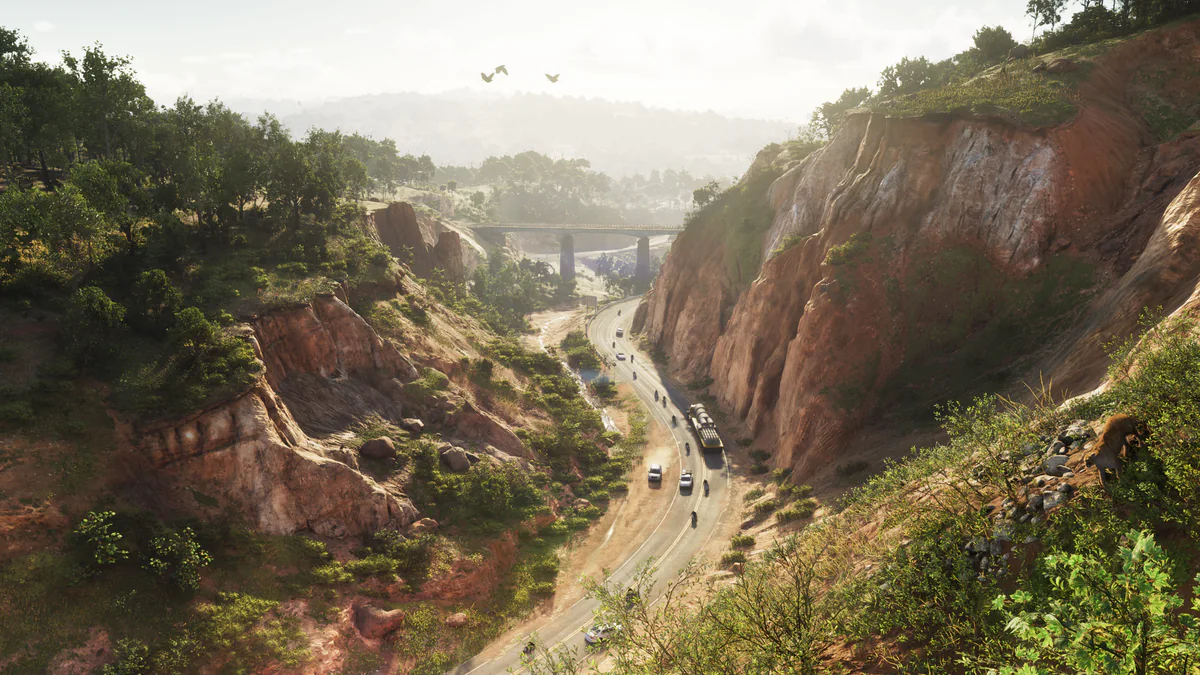
Image: Rockstar Games. Official GTA VI press screenshot.
An emulator interprets console code at runtime. A static recompiler translates it ahead of time. Both can run console games on PC, and both face the same legal and asset problems. The engineering trade-offs are different.
What the project leaves behind
Two things. First, a proof of interest: tens of thousands of people will pay attention to a credible technical effort, even one with no playable result. Second, a set of forks and derived experiments that may outlive the original repository.
Neither is a PC port. The honest summary is that Leonida was an ambitious, early-stage research project that became a news event faster than it became software. The next page in the story is why it went offline→.
FAQ
Was Leonida an emulator?
No. It used static recompilation, translating the console executable into C or C++ ahead of time and rebuilding it for Windows. An emulator would interpret the original code at runtime.
Did Leonida ever run GTA 6?
It reached a boot window, not gameplay. No public footage showed a menu, a character or controllable play. The project's own maintainers described it as early.
Did Leonida include the game files?
No. The repository reportedly contained code only, with no assets, keys or executable. Users were expected to provide their own copy of the game, which is one reason the project could not offer a simple download.
Who made Leonida?
It was started by a developer known as ItsNotRexed, with around 75 contributors. The creator had previously worked on a static recompilation of Ocarina of Time for Switch 2.
Official source: Rockstar Games: GTA VI ↗
Sources